
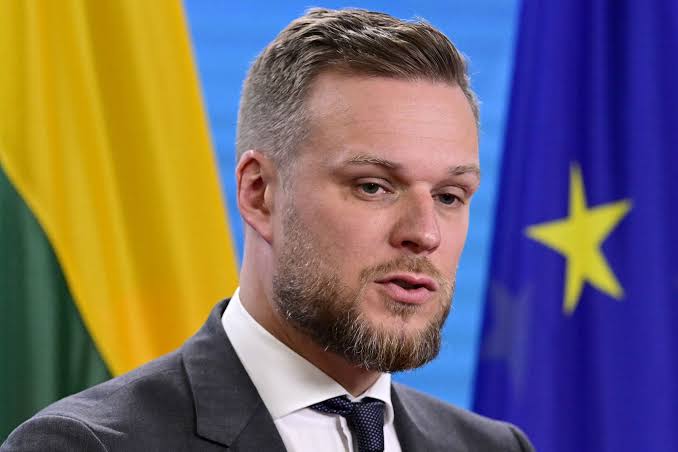
The Lithuanian Foreign Minister, Gabrielius Landsbergis, criticized Hungary on Monday for its diplomatic positions, including its stance on providing military assistance to Ukraine. He stated that the European Union needs to find solutions to bypass Budapest’s veto votes.
Reuters Agency notes that Landsbergis’s criticisms seem to reflect a common frustration among several EU countries as Estonia and Italy have also expressed their dissatisfaction with Budapest’s blocking tactics.
«I think we need to be transparent about what is currently Hungary’s position. Almost all our discussions and necessary solutions and decisions (EU) are blocked by a single country. So we need to start seeing this as a systemic approach to any EU efforts to have a significant impact on foreign relations,» Landsbergis declared on Monday in Brussels, where he arrived for a meeting of foreign ministers of the countries in the community bloc.
EU decisions on foreign policy require the unanimous support of all 27 member states.
Landsbergis also said that Viktor Orban’s government is blocking EU decisions on military assistance for Ukraine, as well as the start of accession talks to the community bloc with Ukraine, Georgia, and Armenia.
«We have analyzed the situation and it seems that about 41% of EU resolutions on Ukraine have been blocked by Hungary,» emphasized the head of Lithuanian diplomacy. He stressed that «things have gone too far».
«We really need to find a way, we as a community, to bypass this,» he said, referring to the veto right used by Viktor Orban’s government.
Reuters Agency notes that his statements are unusually harsh as such frustrations are usually expressed behind closed doors and through diplomatic channels.
Speaking on Monday in Brussels, Estonian Foreign Minister Margus Tsahkna made comments in the same vein.
«Every time we come here we have to convince Hungary not to block very important initiatives,» he emphasized.
Diplomatic sources say that Hungary is currently blocking a series of measures related to the European Instrument for Peace (EPF), an EU fund through which Ukraine has received billions of euros in military assistance.
«It is crucial now for both Ukraine and Europe to use these EPF funds,» Tsahkna further declared.
A similar position was expressed by Italian Foreign Minister Antonio Tajani, despite the close relations between Viktor Orban’s government and that of Giorgia Meloni.
«We are against blockages. We want to move forward,» he declared.
A high-ranking European diplomat told Reuters on condition of anonymity that the actions of the Hungarian government are «scandalous».
«It’s scandalous what’s happening. At every step, you see the Hungarians obstructing Ukraine’s ability to fight against an aggressor,» he said.
The Hungarian government vetoed on December 6 a package of macroeconomic assistance worth 18 billion dollars prepared by the EU for Ukraine and then, on December 15, the multi-year assistance package worth 50 billion dollars.
This second assistance package was eventually accepted on February 1 of this year, Viktor Orban stating then that he had no choice but to accept.
