
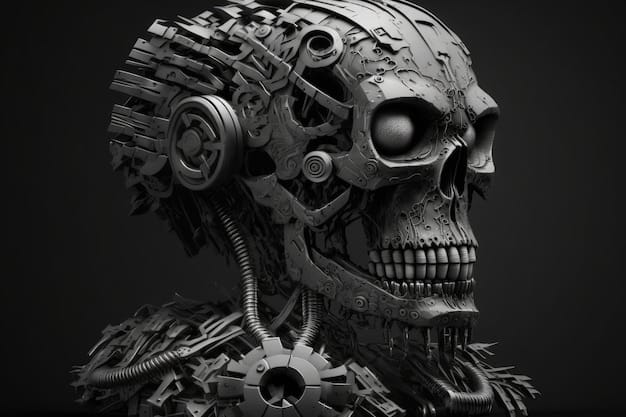
As Artificial Intelligence advances, its detractors also emerge. Some researchers issue alarming warnings, while others consider it a simple tool. Podcast creator Lex Fridman stated in a recent episode that most AI specialists he speaks with estimate that the probability of artificial general intelligence ultimately destroying humanity is between 1 and 20%.
The prediction varies depending on how you ask, he says. For example, a recent study conducted with 2.70 AI researchers indicated that there is only a 5% chance that artificial intelligence will lead to the disappearance of humans. But Fridman said it is important to talk to people who estimate a much higher probability that AI will eliminate people.
He invited AI researcher Roman Yampolskiy to his podcast, who offered the most pessimistic scenario: a 9.9% chance that AI will destroy humanity in the next hundred years. The AI researcher teaches computer science at the University of Louisville and has just published a book titled «AI: Unexplainable, Unpredictable, Uncontrollable». The podcast garnered over half a million views in a few days.
He discussed the risks of artificial intelligence for over two hours on Fridman’s podcast — and his predictions were quite bleak. He said that the chances of AI eliminating humanity depend on people’s ability to create extremely complex, error-free software in the next 10 years. Yampolskiy said he finds this unlikely, as no artificial intelligence model has been completely safe. «They have already made mistakes,» said Yampolskiy.
G4Media asked the question «What is the probability that AI will destroy humanity?» to version 4.0 of ChatGPT, considered more advanced than its previous version. Here is the answer:
1. Current State of AI Technology: AI is not sufficiently developed at present. Today’s available AI technologies are usually specialized for specific tasks (for example, image recognition, language translation). These systems do not possess general intelligence or autonomous decision-making capabilities that could lead to catastrophic results on their own.
2. Risk Scenarios: Abusive Use by Humans: One of the more immediate risks is the abusive use of AI by humans. For example, AI could be used to create autonomous weapons, carry out cyber attacks, or manipulate information and economies. This abusive use could lead to significant damage and instability.
3. Expert Opinions: Optimists: Some experts believe that, through careful development, regulation, and ethical considerations, AI can be beneficial and its risks can be managed. They advocate for strong governance, transparency, and international cooperation.
4. Mitigation Strategies: AI Safety Research: AI safety research aims to develop methods to ensure that AI systems are reliable, controllable, and aligned with human values. This includes developing frameworks for value alignment, robustness, and transparency.
Conclusion: The chances of AI destroying the world depend on several factors, including how AI technologies are developed, governed, and controlled. While the risk of AI causing catastrophic damage is not zero, it is a risk that can potentially be mitigated through proactive measures in research, ethics, and politics. Ensuring the safe development and implementation of AI is a collective responsibility that requires the cooperation of technologists, policy makers, and society as a whole.
